
Building Integrity Institutional Enhancement Course: Human Resources Management (BI-HRM)
In cooperation with
Centre for Integrity in the Defence Sector (CIDS) – Department Head for the Building Integrity Discipline and NATO International Staff – Requirement Authority for the Building Integrity Discipline


| ETOC Course Code | BIT-BI-25676 |
| Eprime course code | ACT.888 |
| Course duration | 5 days |
| Frequency | once a year |
| Class size | Maximum number of students per Iteration: 25 (addresses NATO partner countries and all countries taking part in the BI Self-Assessment and Peer Review Process.) |
| Participants |
|
Course goals:
- The course aim is to provide insights that will inform efforts in the defence sector, consistent with the NATO Building Integrity (Bl) Policy and promoting integrity, transparency and accountability related to Human Resources Management.
Language qaalification:
- English language proficiency as described in STANAG 6001-2222
(listening (fair/2), speaking (fair/2), reading (fair/2), and writing (fair/2).
Course description:
- The course provides a broad introduction to the principles and standards of international conventions and other agreements that regulate a modern and efficient HRM system in the public sector, including the Armed Forces. These principles and standards provide public servants with protection from abuse of political power or other positions of authority and include recruitment of personnel, promotion, remuneration, etc. Such a meritocratic public service, based on transparent rules, competence, accountability, and independent judgment, represents a prerequisite in a modern democracy characterized by the rule of law.
- The course emphasizes two dimensions of public HRM systems: institutional and managerial aspects. The former regards the role of public officials in protecting fundamental values in a political system, like democracy, individual rights, the rule of law, and the public interest. To promote these values public officials are obliged to be loyal to the government of the day but, at the same time, to be impartial, politically neutral and professionally independent. The managerial aspects cover mainly economic-related concerns of good governance in the public sector.
Learning objectives:
Upon the course completion, the course participants will be able to:
- Understand what constitutes Integrity Building in the wider perspective and context, according to internationally recognized standards for best practice;
- Understand the relation between having a professional public service and reliability of defence decision making and be able to discuss this in a good governance context;
- Understand what constitutes Attitudes, Ethics and Leadership (AEL) in an institutional perspective – case study Norwegian experience;
- Understand reasons for when competency reform can be needed in the defence sector and what objectives could be met. Case study from a NATO nation;
- Be informed about and ready to discuss the main international principles and standards that guide how civil service and public administration impact defence sector HRM systems;
- Understand the components of the legal framework for a good practice public administration in which defence institutions are a part of;
- Understand in what areas HRM tools are used, what these tools can constitute and how they are practiced in the defence sector;
- (TBD) Understand what oligarchy means, how this system nurtures corrupt behavior and consequences for HRM.
Building Integrity Institutional Enhancement Course: Integrity Action Plan (BI-IAP)
In cooperation with
Centre for Integrity in the Defence Sector (CIDS) – Department Head for the Building Integrity Discipline and NATO International Staff – Requirement Authority for the Building Integrity Discipline
| ETOC Course Code | BIT-BI- 36711 |
| Eprime course code | ACT.935 |
| Course duration | 5 days |
| Frequency | once a year |
| Class size | Maximum number of students per Iteration: 25 (addresses NATO partner countries and all countries taking part in the BI Self-Assessment and Peer Review Process.) |
| Participants |
|
Course goals:
- The course aim is to provide a practical guide to the development and implementation of an integrity action plan for the defence sector.
Target Audience:
- Practitioners responsible for BI and anti-corruption action planning and implementation in national defence institutions and NCS/NFS.
Language qaalification:
- English language proficiency as described in STANAG 6001-2222
(listening (fair/2), speaking (fair/2), reading (fair/2), and writing (fair/2).
Training Strategy:
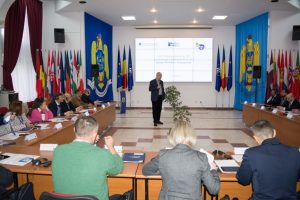
- The course is held over three to five days and the format includes plenary lectures, syndicate work and table-top exercises, discussions led by subject matter experts, and case studies. Active engagement from participants is required throughout the course.
- The course is taught on DRESMARA site in Brasov.
- Lectures are conducted in an interactive manner, which facilitates the exchange of ideas and experiences between professors and course participants. These sessions are followed by syndicate and seminar work, in which course participants are required to solve various problems, case studies and practical activities, whose conclusions or solutions are then presented in front of the entire class as briefings and assessed by the instructors.
PERFORMANCE OBJECTIVES (POs):
- PO 1: By understanding what constitutes Integrity Building in the wider perspective and context, according to internationally recognized standards for best practice, the participants will put the impact on corruption risks in their own defence establishment into context and will provide arguments for how an integrity action plan can mitigate the risks;
- PO 2: By discussing the assessment and analysis tools available, ways and ends for encouraging support and ownership the participants will explain how to assess and analyze corruption risks, and what tools are available and how to build support.
- PO 3: By understanding the need for a broad strategy for developing and implementing an integrity plan and how to link it to the political context the participants will provide ideas on strategy models, scopes and the politics involved.
- PO 4: By identifying which factors to take into consideration when drafting and producing, subsequently leading to implementation of an integrity action plan the participants will provide insightful and systematic arguments for good planning of integrity plan development.
- PO 5: By examining what factors must be considered which influence the implementation of an integrity action plan the participants will provide insight into the transition from planning and drafting to make the implementation phase work.
- PO 6: By summarizing how evaluation and monitoring processes can be organized and followed up in order to get expected results the participants will provide insight into the most important factors to consider in the evaluation and monitoring phases.